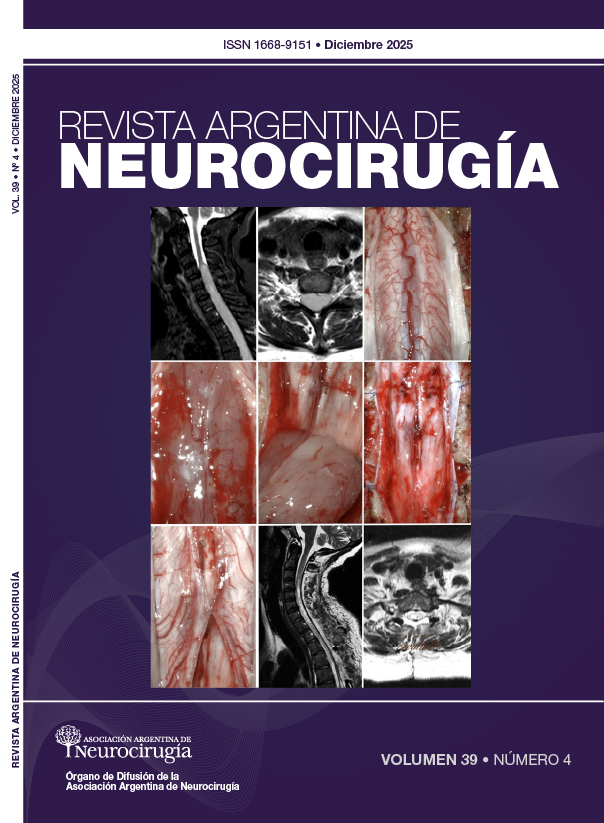
Anatomía del tracto corticoespinal y su importancia en la resección de cavernomas pontinos
DOI:
https://doi.org/10.59156/revista.v39i04.787Palavras-chave:
Cavernoma pontino, Corticoespinal, Disección, TractografíaResumo
Introducción: la resección quirúrgica de los cavernomas pontinos representa un desafío debido a la densidad de estructuras neurales críticas en esta región, entre ellas el tracto corticoespinal (TCE).
Objetivos: realizar una descripción detallada del trayecto del TCE en disecciones y tractografías, con el fin de definir parámetros anatómicos que permitan evitar lesiones de dicho tracto durante la cirugía de la protuberancia.
Material y método: se realizaron tractografias con el software DSI Studio en 1065 cerebros de sujetos sanos pertenecientes al Human Connectome Project para ilustrar el TCE. Se disecaron 6 troncos del encéfalo con instrumental microquirúrgico y el método Klingler.
Resultado: en las tractografías, las fibras del TCE se encontraban ventralmente relacionadas con el estrato superficial de las fibras ESTP y dorsalmente con el EPTP, separadas de la calota de la protuberancia por el LM. Relaciones del TCE en disecciones: hacia ventral, se resecó entre 1.1-2 mm del ESTP. Hacia lateral, se identificó el EMTP y se realizó una resección hasta el origen aparente del NC V, localizado a una distancia de 3.9-4.1 mm del TCE, la disección profunda permitió ubicar el núcleo espinal trigemino a una profundidad de 10.2-12.4 mm. Hacia dorsal, se identificó el EPTP que separaba las fibras piramidales del LM.
Conclusión: los hallazgos obtenidos permiten definir parámetros anatómicos concretos como referencias quirúrgicas clave. La disposición de fibras transversas pueden ser utilizados durante la planificación y ejecución de abordajes quirúrgicos pontinos.
Downloads
Referências
1. Cervio A, Giovanini S, Nuñez M, Caffaratti G, Grijalba Romero M, Villamil F, y col. Tratamiento quirúrgico de los cavernomas de tronco cerebral. Rev Latinoam Neurocir. 2020;29(5):90-119.
2. Catapano JS, Rumalla K, Srinivasan VM, Lawrence PM, Keil KL, Lawton MT. A taxonomy for brainstem cavernous malformations: subtypes of medullary lesions. J Neurosurg. 2022;138(1):128-46. DOI: https://doi.org/10.3171/2022.3.JNS22626
3. Catapano JS, Rumalla K, Srinivasan VM, Lawrence PM, Keil KL, Lawton MT. A taxonomy for brainstem cavernous malformations: subtypes of midbrain lesions. J Neurosurg. 2021;136(6):1667-86. DOI: https://doi.org/10.3171/2021.8.JNS211694
4. Cantore G, Missori P, Santoro A. Cavernous angiomas of the brain stem. Surg Neurol. 1999;52:84-94. DOI: https://doi.org/10.1016/S0090-3019(99)00036-1
5. Bello L, Castellano A, Fava E, Casaceli G, Riva M, Scotti G, et al. Intraoperative use of diffusion tensor imaging fiber tractography and subcortical mapping for resection of gliomas: technical considerations. Neurosurg Focus. 2010;28(2):E6. DOI: https://doi.org/10.3171/2009.12.FOCUS09240
6. Fernández-Miranda JC, Pathak S, Engh J, Jarbo K, Verstynen T, Yeh FC, y col. High-definition fiber tractography of the human brain: neuroanatomical validation and neurosurgical applications. Neurosurgery. 2012;71(2):430-53. DOI: https://doi.org/10.1227/NEU.0b013e3182592faa
7. Maesawa S, Fujii M, Nakahara N, Watanabe T, Wakabayashi T, Yoshida J. Intraoperative tractography and motor evoked potential (MEP) monitoring in surgery for gliomas around the corticospinal tract. World Neurosurg. 2010;74(1):153-61. DOI: https://doi.org/10.1016/j.wneu.2010.03.022
8. Yagmurlu K, Rhoton AL Jr, Tanriover N, Bennett JA. Three-dimensional microsurgical anatomy and the safe entry zones of the brainstem. Oper Neurosurg (Hagerstown). 2014;10(4):602-20. DOI: https://doi.org/10.1227/NEU.0000000000000466
9. Berman JI, Berger MS, Mukherjee P, Henry RG. Diffusion-tensor imaging-guided tracking of fibers of the pyramidal tract combined with intraoperative cortical stimulation mapping in patients with gliomas. J Neurosurg. 2004;101(1):66-72. DOI: https://doi.org/10.3171/jns.2004.101.1.0066
10. Ordóñez-Rubiano EG. Anatomía microquirúrgica en 3D del tracto corticoespinal y de la vía del lemnisco basada en microdisección de fibras y demostración a través de tractografía. Neurocirugía. 2019;30(6):309-10. DOI: https://doi.org/10.1016/j.neucir.2018.11.005
11. Kovanlikaya I, Firat Z, Kovanlikaya A, Uluğ AM, Cihangiroglu MM, John M, y col. Assessment of the corticospinal tract alterations before and after resection of brainstem lesions using Diffusion Tensor Imaging (DTI) and tractography at 3T. Eur J Radiol. 2011;77(3):383-91. DOI: https://doi.org/10.1016/j.ejrad.2009.08.012
12. Chenot Q, Tzourio-Mazoyer N, Rheault F, Descoteaux M, Crivello F, Zago L, y col. A population-based atlas of the human pyramidal tract in 410 healthy participants. Brain Struct Funct. 2019;224(2):599-612. DOI: https://doi.org/10.1007/s00429-018-1798-7
13. Recalde RJ, Figueiredo EG, de Oliveira E. Microsurgical anatomy of the safe entry zones on the anterolateral brainstem related to surgical approaches to cavernous malformations. Oper Neurosurg (Hagerstown). 2008;62(Suppl 3):9-17. DOI: https://doi.org/10.1227/01.neu.0000317368.69523.40
14. Yao Y, Ulrich NH, Guggenberger R, Alzarhani YA, Bertalanffy H, Kollias SS. Quantification of corticospinal tracts with diffusion tensor imaging in brainstem surgery: prognostic value in 14 consecutive 159 cases at 3T magnetic resonance imaging. World Neurosurg. 2015;83(6):1006-14. DOI: https://doi.org/10.1016/j.wneu.2015.01.045
15. Kwon HG, Son SM, Chang MC, Kim S, Kwon YH, Jang SH. Characteristics of the aberrant pyramidal tract in comparison with the pyramidal tract in the human brain. BMC Neurosci. 2011;12:108. DOI: https://doi.org/10.1186/1471-2202-12-108
16. Benner D, Hendricks BK, Benet A, Graffeo CS, Scherschinski L, Srinivasan VM, y col. A system of anatomical triangles defining dissection routes to brainstem cavernous malformations: definitions and application to a cohort of 183 patients. J Neurosurg. 2022;138(3):768-84. DOI: https://doi.org/10.3171/2022.6.JNS212907
17. Abla AA, Lekovic GP, Turner JD, de Oliveira JG, Porter R, Spetzler RF. Advances in the treatment and outcome of brainstem cavernous malformation surgery: a single-center case series of 300 surgically treated patients. Neurosurgery. 2011;68(2):403-14. DOI: https://doi.org/10.1227/NEU.0b013e3181ff9cde
18. Vassal F, Schneider F, Nuti C. Intraoperative use of diffusion tensor imaging-based tractography for resection of gliomas located near the pyramidal tract: comparison with subcortical stimulation mapping and contribution to surgical outcomes. Br J Neurosurg. 2013;27(5):668-75. DOI: https://doi.org/10.3109/02688697.2013.771730
19. Catapano JS, Rumalla K, Srinivasan VM, Lawrence PM, Keil KL, Lawton MT. A taxonomy for brainstem cavernous malformations: subtypes of pontine lesions. Part 1: basilar, peritrigeminal, and middle peduncular. J Neurosurg. 2022;137(5):1462-76. DOI: https://doi.org/10.3171/2022.1.JNS212690