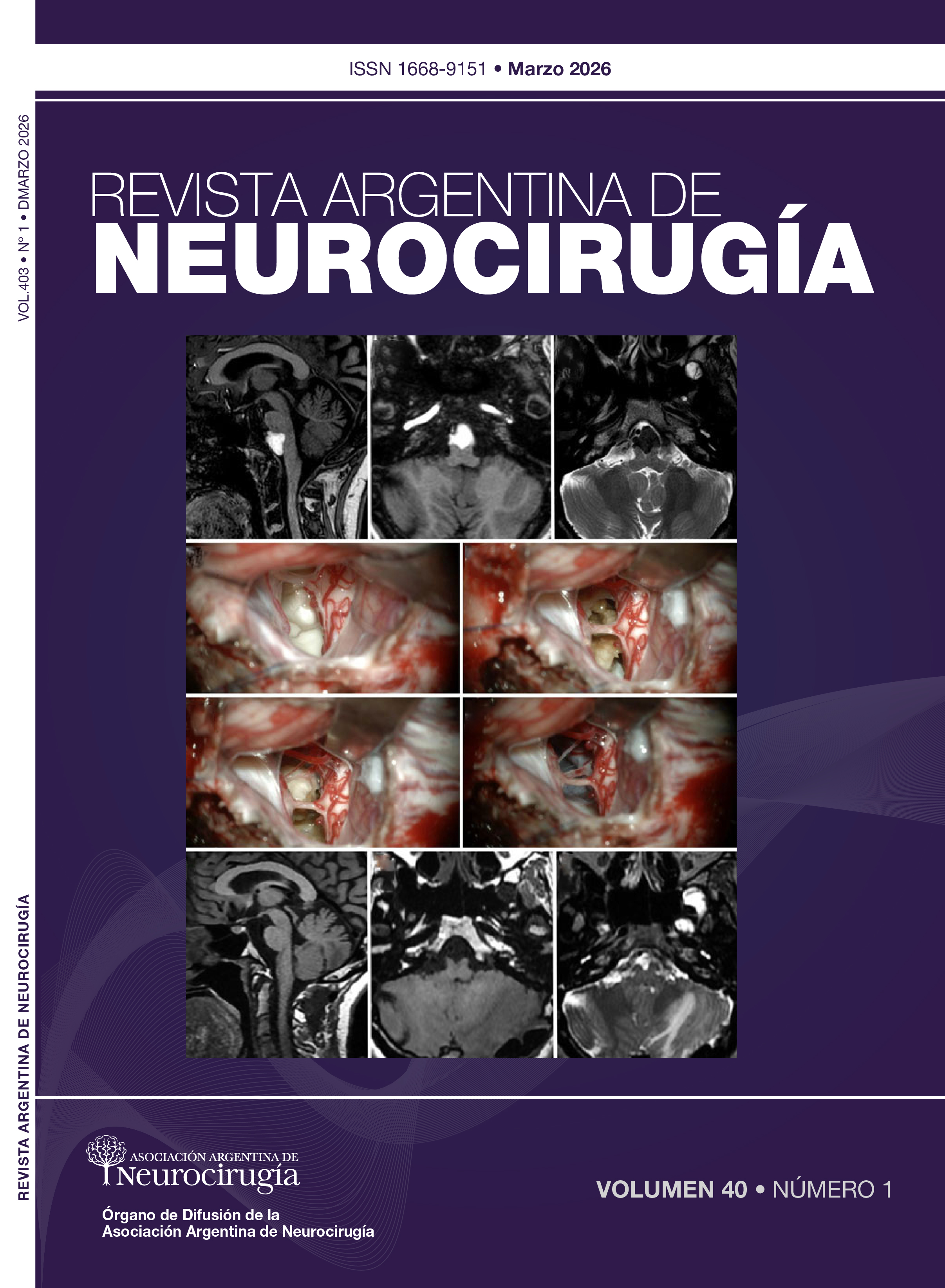
Parry-Romberg syndrome with contralateral trigeminal neuralgia: A rare combination or an incidental finding?
DOI:
https://doi.org/10.59156/revista.v40i01.795Keywords:
Neurocutaneous syndrome, Parry-Romberg síndrome, Progressive hemifacial atrophy, Trigeminal neuralgiaAbstract
Background: Parry-Romberg syndrome, also known as progressive hemifacial atrophy, is a rare acquired neurocutaneous disorder of unclear etiology. Proposed pathogenic mechanisms include trauma, autoimmune processes, sympathetic nervous system dysfunction, and infections. The disease predominantly affects children and young adults, with a female predominance. Clinical manifestations may involve neurological, ophthalmological, and musculoskeletal systems. The course is typically insidious, progressive, and self-limited, stabilizing over a period of 2 to 20 years. Diagnosis is primarily clinical and may be supported by imaging and histopathological findings. Treatment aims to control disease activity and minimize long-term sequelae.
Objectives: to report a case of unilateral progressive hemifacial atrophy incidentally associated with contralateral trigeminal neuralgia.
Case description: a 69-year-old woman with a history of remote facial trauma developed self-limited, asymptomatic left progressive hemifacial atrophy. She also presented with a 15-year history of right trigeminal neuralgia refractory to medical therapy and radiosurgery. Magnetic resonance imaging demonstrated a right-sided neurovascular conflict involving the anterior inferior cerebellar artery.
Surgery: microsurgical decompression of the right trigeminal nerve was performed through a retrosigmoid approach, with interposition of polytetrafluoroethylene between the nerve and the offending vessel. No perioperative complications occurred.
Conclusion: we report a case of late-diagnosed left Parry-Romberg syndrome associated with right trigeminal neuralgia secondary to a neurovascular conflict successfully treated with microsurgical decompression. The opposite laterality of both conditions and intraoperative confirmation of the vascular conflict suggest an incidental coexistence rather than a direct pathophysiological relationship.
Downloads
References
1. El-Kehdy J, Abbas O, Rubeiz N. A review of Parry-Romberg syndrome. J Am Acad Dermatol. 2012 Oct;67(4):769-84. Doi: 10.1016/j.jaad.2012.01.019 DOI: https://doi.org/10.1016/j.jaad.2012.01.019
2. Wong M, Phillips CD, Hagiwara M, Shatzkes DR. Parry Romberg syndrome: 7 cases and literature review. AJNR Am J Neuroradiol. 2015 Jul;36(7):1355-61. Doi: 10.3174/ajnr.A4297 DOI: https://doi.org/10.3174/ajnr.A4297
3. Foiadelli T, Rossi A, Trabatti C, Spreafico E, Santi V, Orsini A, y col. Headache in progressive facial hemiatrophy (Parry-Romberg syndrome): a paradigmatic case and systematic review of the literature. Cephalalgia. 2022 Apr;42(4-5):409-25. Doi: 10.1177/03331024211043452 DOI: https://doi.org/10.1177/03331024211043452
4. Tolkachjov SN, Patel NG, Tollefson MM. Progressive hemifacial atrophy: a review. Orphanet J Rare Dis. 2015 Apr;10(1):39. Doi: 10.1186/s13023-015-0250-9 DOI: https://doi.org/10.1186/s13023-015-0250-9
5. Arif T, Fatima R, Sami M. Parry-Romberg syndrome: a mini review. Acta Dermatovenerol Alp Pannonica Adriat. 2020 Dec;29(4):193-9. Doi: 10.15570/actaapa.2020.39 DOI: https://doi.org/10.15570/actaapa.2020.39
6. Khanduri S, Singh A, Agrawal S, Katyal G. Parry Romberg syndrome. Indian J Otolaryngol Head Neck Surg. 2019 Oct;71(Suppl 1):42-4. Doi: 10.1007/s12070-016-0981-5 DOI: https://doi.org/10.1007/s12070-016-0981-5
7. Dalla Costa G, Colombo B, Dalla Libera D, Martinelli V, Comi G. Parry Romberg syndrome associated with chronic facial pain. J Clin Neurosci. 2013;20(9):1320-2. Doi: 10.1016/j.jocn.2012.08.020 DOI: https://doi.org/10.1016/j.jocn.2012.08.020
8. Carreño-Pérez P. Parry-Romberg, un síndrome neurocutáneo: presentación de tres casos. Rev Med Inst Mex Seguro Soc. 2021;59(3). DOI: https://doi.org/10.24875/RMIMSS.M20000042
9. Viana M, Glastonbury CM, Sprenger T, Goadsby PJ. Trigeminal neuropathic pain in a patient with progressive facial hemiatrophy (Parry-Romberg syndrome). Arch Neurol. 2011 Jul;68(7):938-43. Doi: 10.1001/archneurol.2011.126 DOI: https://doi.org/10.1001/archneurol.2011.126
10. Vix J, Mathis S, Lacoste M, Guillevin R, Neau JP. Neurological manifestations in Parry-Romberg syndrome: 2 case reports. Medicine (Baltimore). 2015 Jul;94(28):e1147. Doi: 10.1097/MD.0000000000001147 DOI: https://doi.org/10.1097/MD.0000000000001147
11. Juan-Sierra IA. Manifestaciones radiológicas del síndrome de Parry-Romberg: un reporte de caso. Neurociencias J. 2019;25(2):30-7. Doi: 10.51437/nj.v25i2.47
12. César R, Katherine RO, Liney M, Rina B, Julián B. Síndrome de Parry-Romberg. Rev Cienc Biomed. 2015;6(1):142-9. DOI: https://doi.org/10.32997/rcb-2015-2993
13. Schultz KP, Dong E, Truong TA, Maricevich RS. Parry Romberg syndrome. Clin Plast Surg. 2019 Apr;46(2):231-7. Doi: 10.1016/j.cps.2018.11.007 DOI: https://doi.org/10.1016/j.cps.2018.11.007
14. Shah SS, Chhabra M. Parry-Romberg syndrome. In: StatPearls [Internet]. Treasure Island (FL): StatPearls Publishing; 2025.
15. Wei-Feng Z, Yi-Bo Z, Wei-Guo Z. Parry-Romberg syndrome combined with hemifacial spasm: association or chance event? J Craniofac Surg. 2011;22(6):2397-9. DOI: https://doi.org/10.1097/SCS.0b013e318231fe86
16. Walker RH, Fink JK. Morphea and Parry-Romberg syndrome associated with a mixed movement disorder. Parkinsonism Relat Disord. 2013 Dec;19(12):1169-70. Doi: 10.1016/j.parkreldis.2013.07.025 DOI: https://doi.org/10.1016/j.parkreldis.2013.07.025