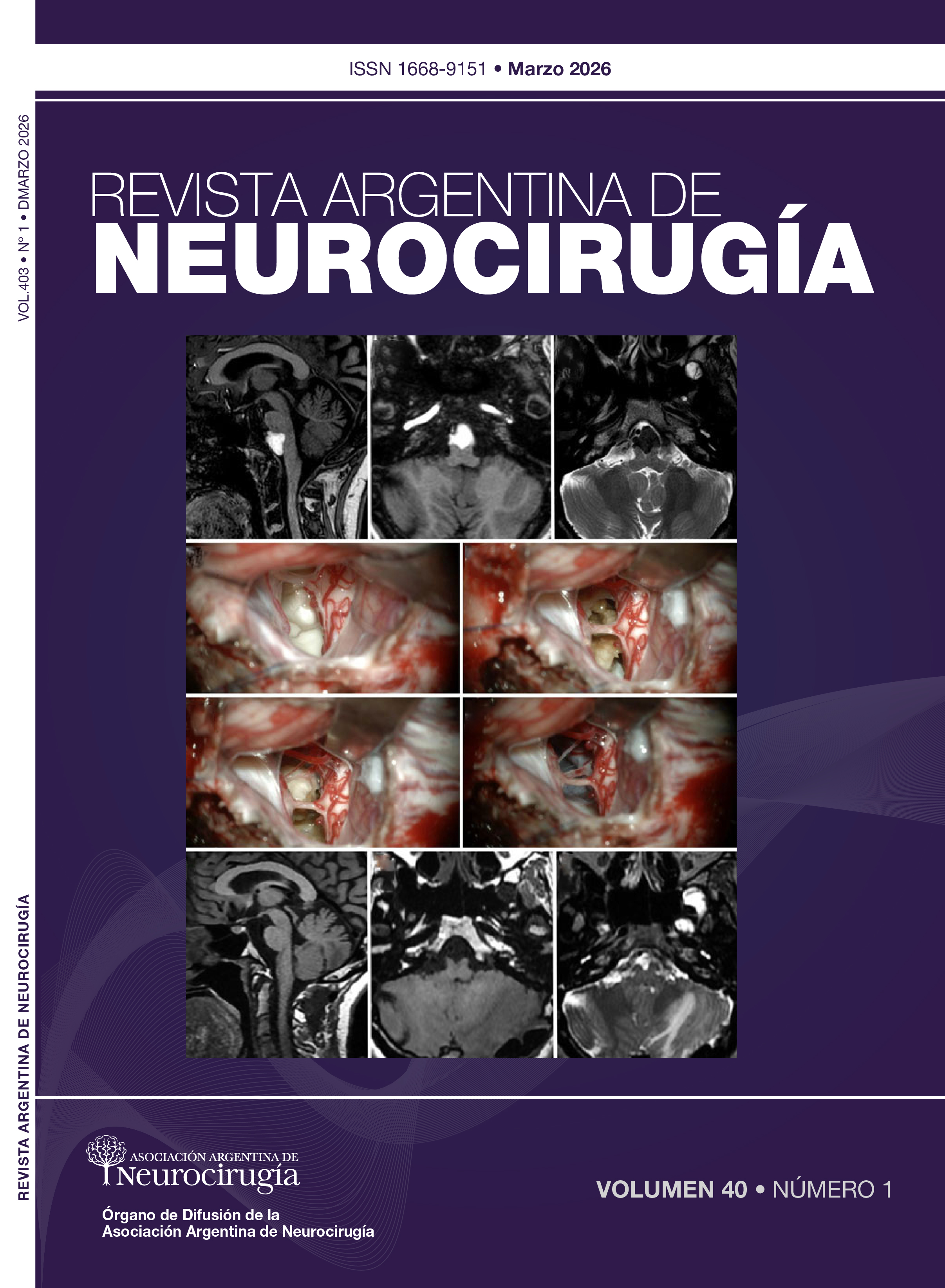
Impact of posterior atlanto-occipital membrane resection on the durability of foramen magnum decompression in pediatric patients with achondroplasia
DOI:
https://doi.org/10.59156/revista.v40i01.794Keywords:
Acondroplasia, Descompresión del foramen magno, Resección de la membrana atlantooccipital posterior, Reintervención quirúrgicaAbstract
Background: foramen magnum decompression (FMD) in patients with achondroplasia may be associated with progressive restenosis and the need for reoperation. Posterior atlanto-occipital membrane resection (PAOMR) is performed in some centers with the aim of increasing the suboccipital space, although its independent impact on decompression durability has not been evaluated in isolation.
Objectives: to assess the association between PAOMR and event-free survival following FMD in pediatric patients with achondroplasia.
Methods: this retrospective single-center study included 33 patients younger than 18 years who underwent primary FMD between 2013 and 2024. Sixteen patients (48%) underwent PAOMR. The primary outcome was event-free survival (EFS), defined as significant reossification (>50% of the canal) or reoperation due to persistent cervicomedullary compression. Kaplan–Meier curves were estimated and compared using the log-rank test. An age-adjusted Cox model (≥24 months) was performed, with internal validation using bootstrap resampling.
Results: thirteen events (39.4%) were recorded. Five-year EFS was 100% in the PAOMR group (no events before 60 months) versus 57.8% in the non-PAOMR group (95% CI 31.1-77.3; log-rank p=0.0018). In the adjusted Cox model, PAOMR was associated with a significant reduction in the risk of an event (HR 0.060; 95% CI 0.0067-0.531; p=0.0115). No complications attributable to PAOMR were observed.
Conclusion: PAOMR was associated with greater durability of FMD without an increase in morbidity. These findings support its systematic incorporation as a technical adjunct in specialized centers, although prospective validation is required.
Downloads
References
1. Orioli IM, Castilla EE, Barbosa-Neto JG. The birth prevalence rates for the skeletal dysplasias. J Med Genet. 1986 Aug;23(4):328-32. Doi: 10.1136/jmg.23.4.328 DOI: https://doi.org/10.1136/jmg.23.4.328
2. Stevenson AC. Achondroplasia: an account of the condition in Northern Ireland. Am J Hum Genet. 1957 Mar;9(1):81-91.
3. Foreman PK, van Kessel F, van Hoorn R, van den Bosch J, Shediac R, Landis S. Birth prevalence of achondroplasia: a systematic literature review and meta-analysis. Am J Med Genet A. 2020 Oct;182(10):2297-316. Doi: 10.1002/ajmg.a.61787 DOI: https://doi.org/10.1002/ajmg.a.61787
4. Horton WA, Hall JG, Hecht JT. Achondroplasia. Lancet. 2007 Jul;370(9582):162-72. Doi: 10.1016/S0140-6736(07)61090-3 DOI: https://doi.org/10.1016/S0140-6736(07)61090-3
5. Bagley CA, Pindrik JA, Bookland MJ, Camara-Quintana JQ, Carson BS. Cervicomedullary decompression for foramen magnum stenosis in achondroplasia. J Neurosurg Pediatr. 2006 Mar;104(3 Suppl):166-72. Doi: 10.3171/ped.2006.104.3.166 DOI: https://doi.org/10.3171/ped.2006.104.3.166
6. Hunter AG, Bankier A, Rogers JG, Sillence D, Scott CI Jr. Medical complications of achondroplasia: a multicentre patient review. J Med Genet. 1998 Sep;35(9):705-12. Doi: 10.1136/jmg.35.9.705 DOI: https://doi.org/10.1136/jmg.35.9.705
7. Morgan DF, Young RF. Spinal neurological complications of achondroplasia. Results of surgical treatment. J Neurosurg. 1980 Apr;52(4):463-72. Doi: 10.3171/jns.1980.52.4.0463 DOI: https://doi.org/10.3171/jns.1980.52.4.0463
8. Hecht JT, Butler IJ. Neurologic morbidity associated with achondroplasia. J Child Neurol. 1990 Apr;5(2):84-97. Doi: 10.1177/088307389000500203 DOI: https://doi.org/10.1177/088307389000500203
9. Thomas IT, Frias JL. The prospective management of cervicomedullary compression in achondroplasia. Birth Defects Orig Artic Ser. 1989;25(4):83-90.
10. Pauli RM, Horton VK, Glinski LP, Reiser CA. Prospective assessment of risks for cervicomedullary-junction compression in infants with achondroplasia. Am J Hum Genet. 1995 Mar;56(3):732-44.
11. Aryanpur J, Hurko O, Francomano C, Wang H, Carson B. Craniocervical decompression for cervicomedullary compression in pediatric patients with achondroplasia. J Neurosurg. 1990 Sep;73(3):375-82. Doi: 10.3171/jns.1990.73.3.0375 DOI: https://doi.org/10.3171/jns.1990.73.3.0375
12. Reid CS, Pyeritz RE, Kopits SE, Maria BL, Wang H, McPherson RW, y col. Cervicomedullary compression in young patients with achondroplasia: value of comprehensive neurologic and respiratory evaluation. J Pediatr. 1987 Apr;110(4):522-30. Doi: 10.1016/S0022-3476(87)80542-5 DOI: https://doi.org/10.1016/S0022-3476(87)80542-5
13. Pauli RM, Scott CI, Wassman ER Jr, Gilbert EF, Leavitt LA, Ver Hoeve J, y col. Apnea and sudden unexpected death in infants with achondroplasia. J Pediatr. 1984 Mar;104(3):342-8. Doi: 10.1016/S0022-3476(84)81092-6 DOI: https://doi.org/10.1016/S0022-3476(84)81092-6
14. Keiper GL Jr, Koch B, Crone KR. Achondroplasia and cervicomedullary compression: prospective evaluation and surgical treatment. Pediatr Neurosurg. 1999 Aug;31(2):78-83. Doi: 10.1159/000028838 DOI: https://doi.org/10.1159/000028838
15. Ryken TC, Menezes AH. Cervicomedullary compression in achondroplasia. J Neurosurg. 1994 Jul;81(1):43-8. Doi: 10.3171/jns.1994.81.1.0043 DOI: https://doi.org/10.3171/jns.1994.81.1.0043
16. Shikata J, Yamamuro T, Iida H, Kono H, Mori E. Surgical treatment of achondroplastic dwarfs with paraplegia. Surg Neurol. 1988 Feb;29(2):125-30. Doi: 10.1016/0090-3019(88)90069-9 DOI: https://doi.org/10.1016/0090-3019(88)90069-9
17. Yamada H, Nakamura S, Tajima M, Kageyama N. Neurological manifestations of pediatric achondroplasia. J Neurosurg. 1981 Jan;54(1):49-57. Doi: 10.3171/jns.1981.54.1.0049 DOI: https://doi.org/10.3171/jns.1981.54.1.0049
18. Stevens EA, Powers AK, Sweasey TA, Tatter SB, Ojemann RG. Simplified harvest of autologous pericranium for duraplasty in Chiari malformation type I. Technical note. J Neurosurg Spine. 2009 Jul;11(1):80-3. Doi: 10.3171/2009.3.SPINE08196 DOI: https://doi.org/10.3171/2009.3.SPINE08196
19. Cools MJ, Quinsey CS, Elton SW. Chiari decompression outcomes using ligamentum nuchae harvest and duraplasty in pediatric patients with Chiari malformation type I. J Neurosurg Pediatr. 2018 Apr;22(1):47-1. Doi: 10.3171/2018.1.PEDS17670 DOI: https://doi.org/10.3171/2018.1.PEDS17670
20. Cheung MS, Irving M, Cocca A, Santos R, Shaunak M, Dougherty H, y col. Achondroplasia Foramen Magnum Score: screening infants for stenosis. Arch Dis Child. 2021 Feb;106(2):180-4. Doi: 10.1136/archdischild-2020-319625 DOI: https://doi.org/10.1136/archdischild-2020-319625
21. Akinnusotu O, Isaacs AM, Stone M, Bonfield CM. Neurosurgical management of cervicomedullary compression, spinal stenosis, and hydrocephalus in pediatric achondroplasia: a systematic review. J Neurosurg Pediatr. 2023 Nov;32(5):597-606. Doi: 10.3171/2023.6.PEDS23162 DOI: https://doi.org/10.3171/2023.6.PEDS23162
22. Smid CJ, Legare JM, Modaff P, Pauli RM. Apparently benign craniocervical signs in achondroplasia: "neurologic leftovers" identified through a retrospective dataset. Orphanet J Rare Dis. 2020 Oct 23;15(1):301. Doi: 10.1186/s13023-020-01584-5 DOI: https://doi.org/10.1186/s13023-020-01584-5