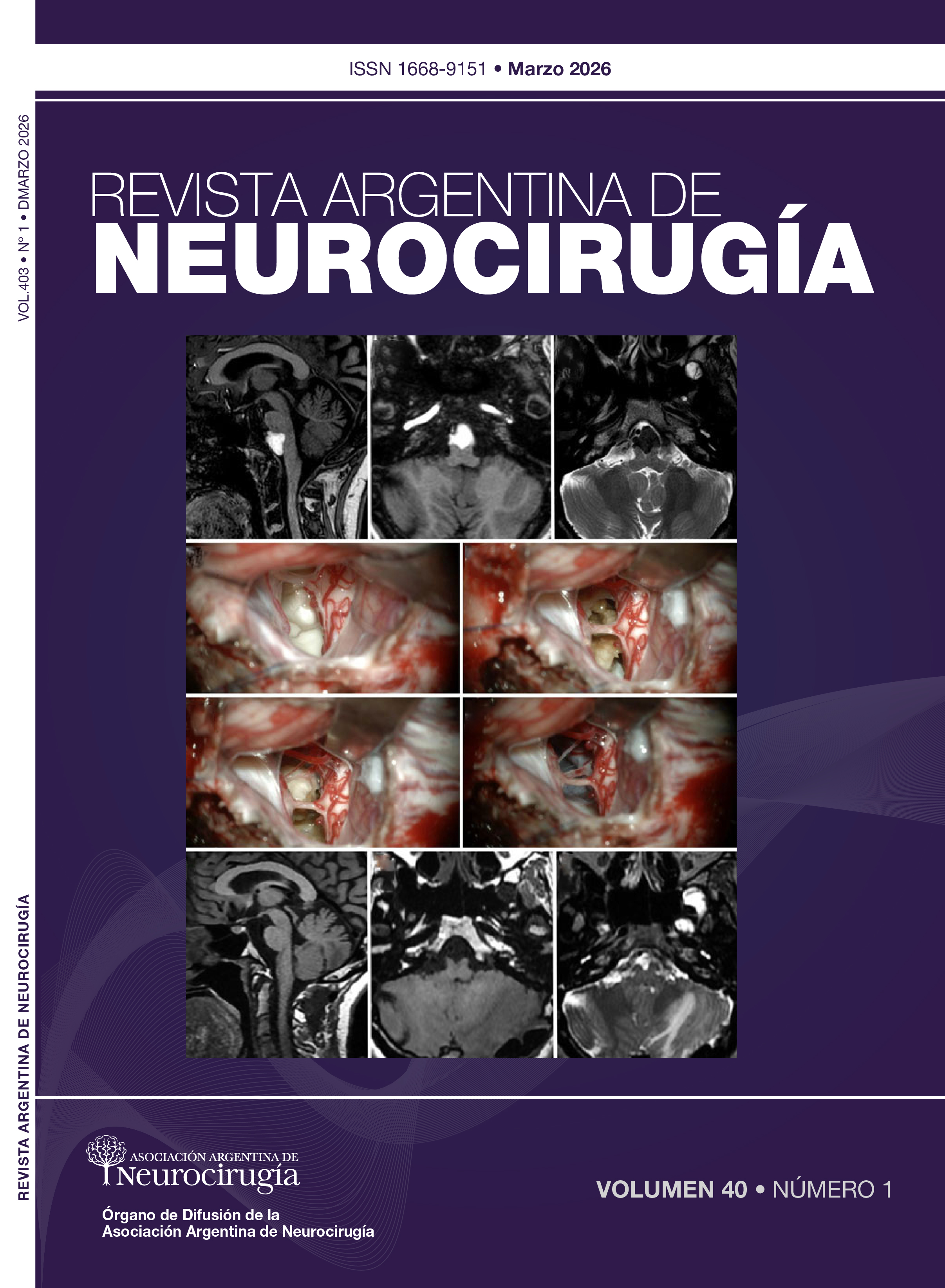
Microvascular decompression for hemifacial spasm: a case-based video presentation
DOI:
https://doi.org/10.59156/revista.v40i01.785Keywords:
Hemifacial spasm, Microvascular decompression, Neurovascular conflict, Retrosigmoid approachAbstract
Background: hemifacial spasm (HFS) is a benign but chronically disabling condition characterized by involuntary contractions of the facial muscles, usually due to a neurovascular conflict between the anterior inferior cerebellar artery (AICA) and the facial nerve. Botulinum toxin is the most common initial treatment, but its efficacy may decrease over time. In such cases, microvascular decompression (MVD) can be a valid therapeutic alternative.
Objectives: to present a surgical video of MVD in a patient with long-standing HFS refractory to botulinum toxin treatment.
Case description: a 68-year-old female patient with a history of myocardial infarction, cardiac arrhythmia, and prior aneurysm clipping, presented with hemifacial spasm (HFS) diagnosed at age 25. She had been treated with botulinum toxin for more than three decades, with progressively diminishing response. Physical examination demonstrated a typical left hemifacial spasm. MRI revealed a neurovascular conflict between the AICA and the facial nerve. A microvascular decompression (MVD) was performed through a left retrosigmoid approach in the park-bench position, identifying the conflict and placing Teflon at the neurovascular interface.
Results: the patient experienced complete resolution of symptoms in the immediate postoperative period, with no complications or recurrence during clinical follow-up.
Conclusion: this case illustrates the feasibility and efficacy of microvascular decompression for the treatment of hemifacial spasm caused by a neurovascular conflict. The procedure resulted in complete symptom resolution without postoperative complications.
Downloads
References
Youmans JR, Winn HR, eds. Youmans and Winn Neurological Surgery. 8th ed. Philadelphia: Elsevier; 2017. Trigeminal neuralgia and other cranial rhizopathies. Microvascular decompression for hemifacial spasm.
Rhoton AL Jr. The cerebellopontine angle and posterior fossa cranial nerves by the retrosigmoid approach. In: Cranial anatomy and surgical approaches. Philadelphia: Wolters Kluwer Health; 2023.
Soriano-Baron H, Vales-Hidalgo O, Arvizu-Saldana E, Moreno-Jimenez S, Revuelta-Gutierrez R. Hemifacial spasm: 20-year surgical experience, lessons learned. Surg Neurol Int. 2015;6:83. doi:10.4103/2152-7806.157443. DOI: https://doi.org/10.4103/2152-7806.157443
Hyun SJ, Kong DS, Park K. Microvascular decompression for treating hemifacial spasm: lessons learned from a prospective study of 1,174 operations. Neurosurg Rev. 2010;33(3):325-334. doi:10.1007/s10143-010-0254-9. DOI: https://doi.org/10.1007/s10143-010-0254-9
Campero A, Cuervo-Arango Herreros I, Barrenechea I, Andjel G, Ajler P, Rhoton A. Descompresión microvascular en espasmo hemifacial: reporte de 13 casos y revisión de la literatura. Surg Neurol Int. 2016;7. doi:10.4103/2152-7806.179545. DOI: https://doi.org/10.4103/2152-7806.179545