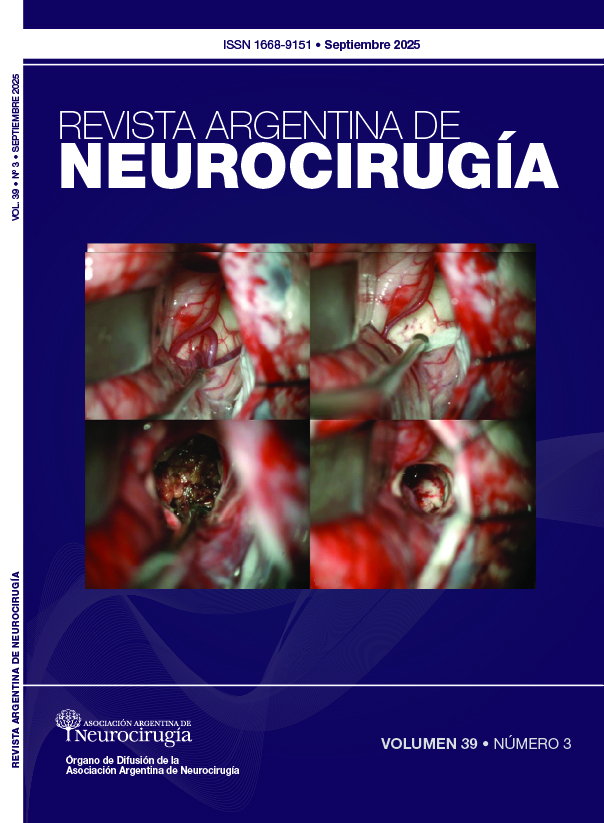
Brainstem cavernomas: a 10-case surgical series
DOI:
https://doi.org/10.59156/revista.v39i03.748Keywords:
Brainstem, Cavernous malformation, Posterior fossa, RetrosigmoidAbstract
Introduction: brainstem cavernomas are low-flow vascular malformations with a high risk of bleeding and significant neurological morbidity. Their surgical management remains challenging due to their location in eloquent brain areas.
Objectives: to present our surgical series of brainstem cavernomas, analyze clinical and imaging outcomes, as well as the approaches used according to their location.
Methods: we conducted a retrospective review of 10 consecutive patients who underwent surgery for brainstem cavernomas between January 2021 and February 2025. Clinical, radiological, surgical, and postoperative outcomes were analyzed.
Results: 6 patients were female; mean age was 39 years. All had prior hemorrhage. Lesions were in the pons (50%), medulla (30%), and midbrain (20%). Surgical approaches were chosen based on lesion location, using suboccipital or extended retrosigmoid routes. Complete resection was achieved in all cases. Six patients fully recovered; 2 had transient neurological deficits. No new permanent sequel was reported.
Conclusion: microsurgical resection of brainstem cavernomas is feasible and safe in experienced centers, with favorable outcomes in most selected cases. Risk stratification tools, such as the Lawton grading scale, support optimal surgical decision-making.
Downloads
References
1. Batra S, Lin D, Recinos PF, Zhang J, Rigamonti D. Cavernous malformations: natural history, diagnosis and treatment. Nat Rev Neurol. 2009 Dec;5(12):659-70.
2. Campero A, Baldoncini M, Villalonga J. Resección microquirúrgica de cavernoma del receso lateral derecho a través de abordaje telovelar. Rev Argent Neuroc. 2019;33(2):107-12.
3. Garcia RM, Ivan ME, Lawton MT. Brainstem cavernous malformations: surgical results in 104 patients and a proposed grading system to predict neurological outcomes. Neurosurgery. 2015 Mar;76(3):265-77; discussion 277-8.
4. Tatagiba M, Lepski G, Kullmann M, Krischek B, Danz S, Bornemann A, Klein J, Fahrig A, y col. The Brainstem Cavernoma Case Series: A formula for surgery and surgical technique. Medicina (Kaunas). 2023 Sep 5;59(9):1601.
5. Cannizzaro D, Sabatino G, Mancarella C, Revay M, Rossi M, Pecchioli G, Cardia A, y col. Management and surgical approaches of brainstem cavernous malformations: our experience and literature review. Asian J Neurosurg. 2019 Jan-Mar;14(1):131-9.
6. Catapano JS, Rutledge C, Rumalla K, Raygor KP, Srinivasan VM, Koester SW, Kimata AR, y col. External validation of the Lawton brainstem cavernous malformation grading system in a cohort of 277 microsurgical patients. J Neurosurg. 2021 Oct 1;136(5):1231-9.
7. Goldstein HE, Solomon RA. Epidemiology of cavernous malformations. Handb Clin Neurol. 2017;143:241-7.
8. Hori T, Chernov M, Alshebib YA, Kubota Y, Matsuo S, Shiramizu H, Okada Y. Long-term outcomes after surgery for brainstem cavernous malformations: analysis of 46 consecutive cases. J Neurosurg. 2022 Sep 9;138(4):900-9.
9. Graffeo CS, Srinivasan VM, Scherschinski L, Benner D, Karahalios K, Devia DA, Catapano JS, Lawton MT. Expanding the reach of the trans-middle cerebellar peduncle approach: pontine cavernous malformations, tissue transgression beyond the safe entry zone, and the invisible triangle. J Neurosurg. 2023 Nov 17;140(5):1344-56.
10. Li Z, Lu J, Liu M, Ma L, Quan K, Zhang H, Liu P, y col. Development and validation of a supplementary grading scale for outcomes of brainstem cavernous malformations. Stroke. 2024 Aug;55(8):1991-2002.