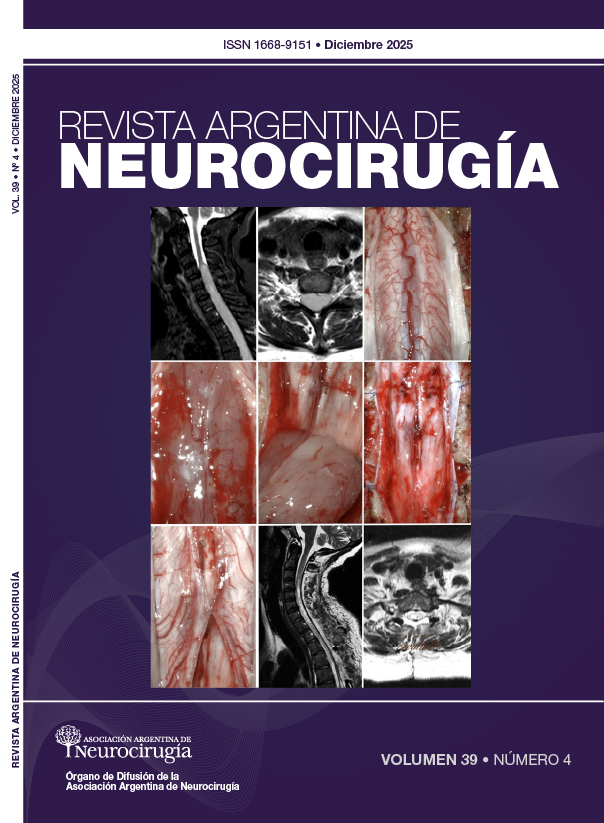
Mapeo cognitivo multimodal en glioma de área motora suplementaria: a propósito de un caso
DOI:
https://doi.org/10.59156/revista.v39i04.767Palabras clave:
Área motora suplementaria, Craneotomía vigil, Glioma difuso de bajo grado, Mapeo cognitivoResumen
Introducción: el glioma difuso de bajo grado es un tumor cerebral que se caracteriza por su lento crecimiento y su progresiva transformación a glioma de alto grado; este, cuando afecta áreas cerebrales elocuentes, como el área motora suplementaria (AMS), representa un reto quirúrgico. El mapeo cognitivo multimodal en estado de vigilia, mediante electroestimulación cortical y subcortical, es esencial para preservar funciones críticas y mejorar la calidad de vida postoperatoria.
Objetivo: realizar una descripción de nuestra técnica quirúrgica de mapeo cognitivo multimodal en paciente despierto para un caso de glioma difuso en área motora suplementaria.
Descripción del caso: paciente masculino de 24 años, sin antecedentes relevantes, que consultó por crisis tonicoclónicas generalizadas de un mes de evolución. Al examen físico paciente bradipsíquico y sin foco neurológico. La resonancia magnética evidenció una lesión infiltrativa en la AMS izquierda, hiperintensa en FLAIR, sin realce con contraste ni restricción en difusión.
Intervención: la intervención quirúrgica siguió un protocolo sedado-despierto-sedado, aplicando mapeo funcional multimodal para identificar los bordes seguros del tumor, permitiendo una resección precisa mientras se monitoreaban funciones motoras y cognitivas en tiempo real.
Conclusión: la neurocirugía oncológica ha evolucionado hacia una resección guiada por el conectoma, optimizando el equilibrio entre control tumoral y preservación funcional. El mapeo cognitivo multimodal es una técnica segura y eficaz para lograr este objetivo en gliomas difusos.
Descargas
Referencias
1. Duffau H. Diffuse low-grade glioma, oncological outcome and quality of life: a surgical perspective: A surgical perspective. Curr Opin Oncol. 2018;30(6):383-9. Doi: http://dx.doi.org/10.1097/CCO.0000000000000483 DOI: https://doi.org/10.1097/CCO.0000000000000483
2. Duffau H. Diffuse low-grade gliomas and neuroplasticity. Diagn Interv Imaging. 2014;95(10):945-55. Doi: http://dx.doi.org/10.1016/j.diii.2014.08.001 DOI: https://doi.org/10.1016/j.diii.2014.08.001
3. Pinson H, Van Lerbeirghe J, Vanhauwaert D, Van Damme O, Hallaert G, Kalala J-P. The supplementary motor area syndrome: a neurosurgical review. Neurosurg Rev. 2022;45(1):81-90. Doi: http://dx.doi.org/10.1007/s10143-021-01566-6 DOI: https://doi.org/10.1007/s10143-021-01566-6
4. Ahmed Khan R, Rahman MM, Ziauddin M, Chowdhury M, Hasan M. Awake brain mapping by direct cortical stimulation; technical note to get higher resection rate and low morbidity in low-grade glioma patients. Ann Med Surg (Lond). 2024;86(4):1861-6. Doi: http://dx.doi.org/10.1097/MS9.0000000000001837 DOI: https://doi.org/10.1097/MS9.0000000000001837
5. De Witt Hamer PC, Robles SG, Zwinderman AH, Duffau H, Berger MS. Impact of intraoperative stimulation brain mapping on glioma surgery outcome: a meta-analysis. J Clin Oncol. 2012;30(20):2559-65. Doi: http://dx.doi.org/10.1200/JCO.2011.38.4818 DOI: https://doi.org/10.1200/JCO.2011.38.4818
6. Duffau H. Awake mapping of the brain connectome in glioma surgery: Concept is stronger than technology. Eur J Surg Oncol. 2015;41(9):1261-3. Doi: http://dx.doi.org/10.1016/j.ejso.2015.05.009 DOI: https://doi.org/10.1016/j.ejso.2015.05.009
7. Duffau H. Neural connectivity: How to reinforce the bidirectional synapse between basic neuroscience and routine neurosurgical practice? Front Neurol. 2021;12:705135. Doi: http://dx.doi.org/10.3389/fneur.2021.705135 DOI: https://doi.org/10.3389/fneur.2021.705135
8. Duffau H. Introducing the concept of brain metaplasticity in glioma: how to reorient the pattern of neural reconfiguration to optimize the therapeutic strategy. J Neurosurg. 2022;136(2):613-7. Doi: http://dx.doi.org/10.3171/2021.5.JNS211214 DOI: https://doi.org/10.3171/2021.5.JNS211214
9. Duffau H. Damaging a few millimeters of the deep white matter tracts during glioma surgery may result in a large-scale brain disconnection. J Neurosurg. 2023;140(1):311-4. Doi: http://dx.doi.org/10.3171/2023.6.JNS231048 DOI: https://doi.org/10.3171/2023.6.JNS231048
10. Duffau H, Lopes M, Denvil D, Capelle L. Delayed onset of the supplementary motor area syndrome after surgical resection of the mesial frontal lobe: a time course study using intraoperative mapping in an awake patient. Stereotact Funct Neurosurg. 2001;76(2):74-82. Doi: http://dx.doi.org/10.1159/000056496 DOI: https://doi.org/10.1159/000056496
11. Duffau H, Lopes M, Arthuis F, Bitar A, Sichez J-P, Van Effenterre R, et al. Contribution of intraoperative electrical stimulations in surgery of low grade gliomas: a comparative study between two series without (1985-96) and with (1996-2003) functional mapping in the same institution. J Neurol Neurosurg Psychiatry. 2005;76(6):845-51. Doi: http://dx.doi.org/10.1136/jnnp.2004.048520 DOI: https://doi.org/10.1136/jnnp.2004.048520
12. Jakola AS, Myrmel KS, Kloster R, Torp SH, Lindal S, Unsgård G, et.al. Comparison of a strategy favoring early surgical resection vs a strategy favoring watchful waiting in low-grade gliomas. JAMA. 2012;308(18):1881-8. Doi: http://dx.doi.org/10.1001/jama.2012.12807 DOI: https://doi.org/10.1001/jama.2012.12807
13. Jakola AS, Skjulsvik AJ, Myrmel KS, Sjåvik K, Unsgård G, Torp SH, et al. Surgical resection versus watchful waiting in low-grade gliomas. Ann Oncol. 2017;28(8):1942-8. Doi: http://dx.doi.org/10.1093/annonc/mdx230 DOI: https://doi.org/10.1093/annonc/mdx230
14. Motomura K, Chalise L, Ohka F, Aoki K, Tanahashi K, Hirano M, et al. Supratotal resection of diffuse frontal lower grade gliomas with awake brain mapping, preserving motor, language, and neurocognitive functions. World Neurosurg. 2018;119:30-9. Doi: http://dx.doi.org/10.1016/j.wneu.2018.07.193 DOI: https://doi.org/10.1016/j.wneu.2018.07.193
15. Pouratian N, Mut M, Jagannathan J, Lopes MB, Shaffrey ME, Schiff D. Low-grade gliomas in older patients: a retrospective analysis of prognostic factors. J Neurooncol. 2008;90(3):341-50. Doi: http://dx.doi.org/10.1007/s11060-008-9669-3 DOI: https://doi.org/10.1007/s11060-008-9669-3